

A couple of years ago, I read We Don’t Know Ourselves: A Personal History of Ireland Since 1958 by the Irish journalist Fintan O’Toole. For anyone with a passing interest in Indian history, Ireland is a natural comparable, given its colonial past and deeply sectarian politics. I read O’Toole at a time I was reading a lot about Ireland more generally. (This mini obsession was started by Patrick Radden Keefe’s Say Nothing: A True Story of Murder and Memory in Northern Ireland. Keefe is probably the best non-fiction writer writing today.)
I bring up O’Toole because what struck me when I was reading him was how little the Ireland he describes resembles Ireland today, and how much it resembles India. The theme that stayed with me most was emigration. As a privileged Indian who first went abroad to study in the 2000s, I have watched the number of people of my age and my class going abroad turn from a trickle into a steady stream. A lot of what O’Toole describes felt familiar, and yet the utter devastation that emigration wreaked on Ireland is in some ways unimaginable in India. The 26 counties that became the Irish state had about 6.5 million people in 1841, and by 1961 that number had fallen to 2.8 million. In the 1950s Ireland and East Germany were the only countries in Europe whose populations shrank. Roughly three in five children who grew up in Ireland in that decade left at some point in their lives. For a young person in a poor, claustrophobic and deeply Catholic country, there was very little to stay for.
And yet the Ireland of today is nothing like the Ireland of the past. There are still plenty of Irish people scattered across the world. But at some point Ireland became a country that could draw its own people back. It opened up its economy, joined what is now the European Union in 1973, grew rich on the back of the global economy, and became a far more vibrant and less religiously overbearing place along the way.
This is a bit of an aside to start on, but it’s a case study I often come back to when I think about emigration from India.
Leaving as ambition
Anmol and I were discussing emigration in the context of a tweet by Deedy Das. Deedy, a venture investor, commentator on the India-US corridor and rage baiter par excellence, argued that “the smartest Indians continue to come to build in the US” because the economic incentives are far better.

He listed close to twenty AI companies with at least one Indian-born founder, along with their valuations. In his telling, the only reasons to stay in India were family, a failed visa or “devout patriotism”. The thread has been commented on and re-X’ed many hundred thousand times.
What he says about AI founders is true. But it is true of pretty much any country vis-à-vis the US when it comes to frontier technology (barring China, for reasons we don’t need to go into here). A British or French or Brazilian founder would feel exactly the same pull.
What I doubt is that the debate is as charged for other nationalities. When it comes to leaving India, the debate often takes on moral terms, and this can go in two opposite directions. One lens is ambition. If you are smart you go, and anyone who stays is staying for sentimental reasons or because they couldn’t make it. The other is nationalism. Why would you leave, rather than stay and do something for your country? Deedy’s jibe about “devout patriotism” mocks the second. The patriotic framing, for its part, ignores the very real reasons life abroad is attractive. I don’t find either very useful, and both barely scratch the surface of how multifaceted the decision to move is, both for the people making it and for the countries involved.
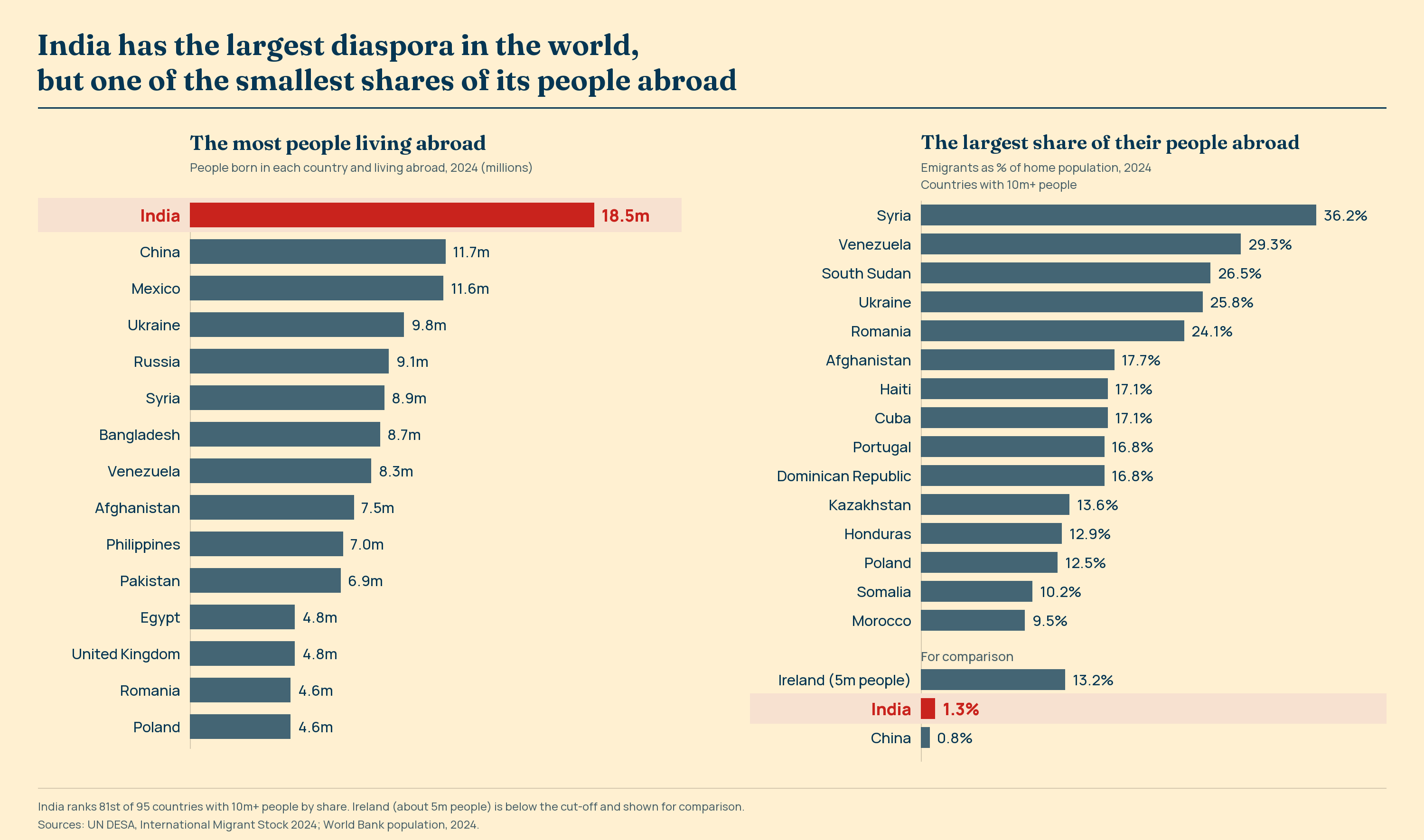
In absolute terms India has the largest diaspora in the world, about 18.5 million people in 2024. As a share of the population, though, that is only about 1.3%. Among the 95 countries with more than 10 million people, India ranks 81st in terms of diaspora as a share of population. The countries at the top of that list are mostly places people are fleeing. More than a third of Syrians live abroad, as do nearly 30% of Venezuelans and about a quarter of Ukrainians. After them come poorer countries next to much richer neighbors: about a quarter of Romanians, one in eight Poles and roughly 9% of Mexicans. Ireland, a country of only about 5 million people, has about 13% of its people living abroad, which puts it squarely in that company. The slice of India that Deedy is talking about is smaller still. About 3.2 million India-born people live in the US, which works out to roughly one Indian in 460.
Moving abroad is nothing new for Indians, though. We have traveled to work and live abroad at scale for a very long time, despite the old taboo against crossing the kala paani. When a young Gandhi decided to sail to England in 1888, the head of his Modh Bania caste declared him an outcaste and said that anyone who helped him or saw him off at the dock would be fined. He sailed anyway.
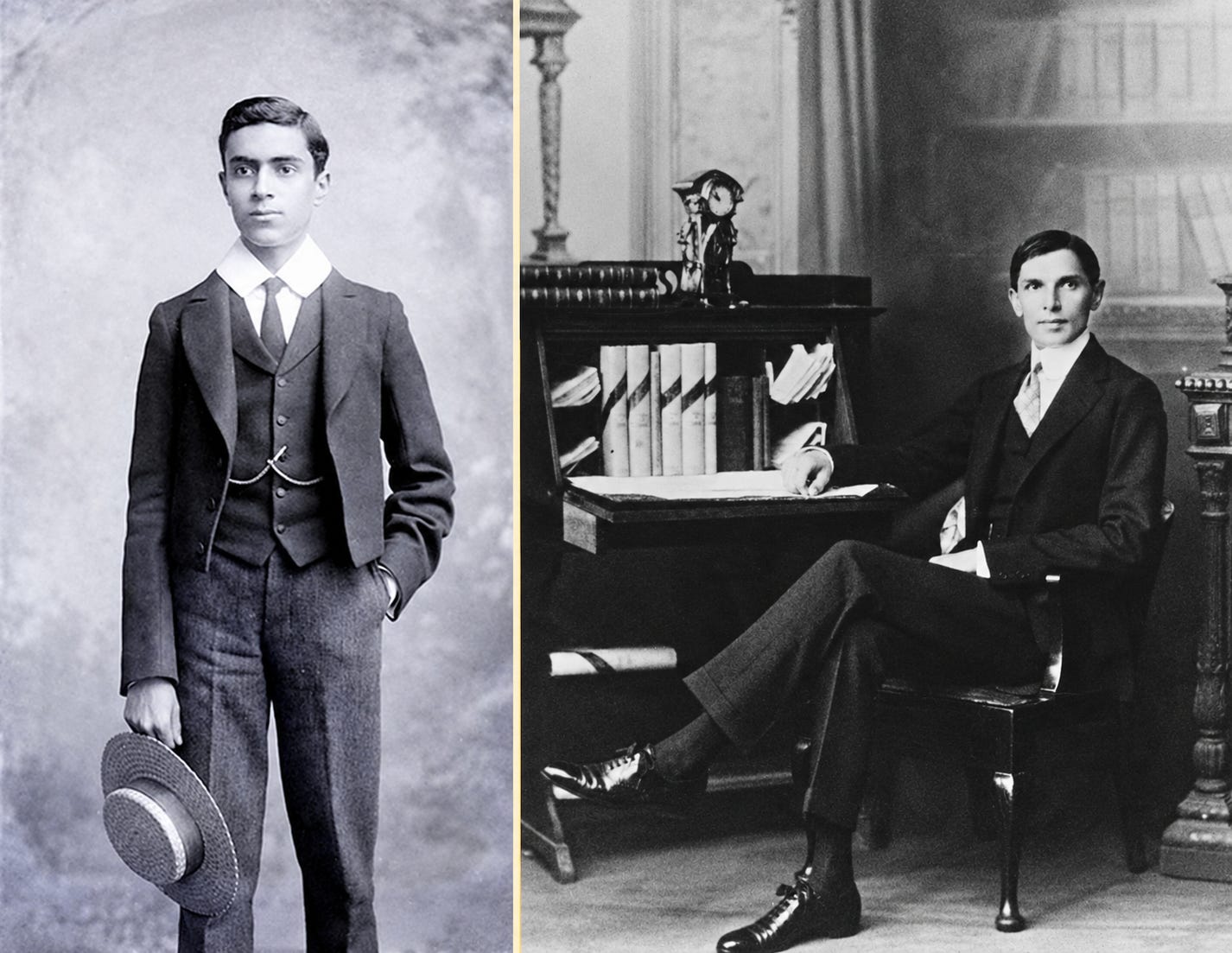
A lot of this movement followed trading routes. Gujarati, Konkani and Chettiar merchants built networks across the Indian Ocean, from East Africa to Burma and Malaya, and once these regions were incorporated into the Empire, these communities did very well out of the open borders that world gave them. Empire also moved people in far crueler ways. Indentured laborers from the Bhojpuri belt of Bihar and eastern UP were shipped to Suriname, Trinidad, Guyana, Fiji and Mauritius. The Punjabis, more worldly because of their military service, went to Canada, California and England. Many went abroad for education. The men who led our national movement were themselves migrants within the empire at one point or another. Gandhi spent two decades in South Africa. Nehru was schooled at Harrow and Cambridge, and Jinnah trained at Lincoln’s Inn and later practiced in London. I suspect this long history is part of why we are so comfortable moving, and why we have diaspora networks to draw on.
Independence changed the rules of the game. For the two hundred years of Company and Crown rule, India had been part of a world of fairly open trade and movement, however unequal its terms. The new state cut itself off from much of that. It turned inward economically, and it kept Indians abroad at arm’s length. In 1964 Nehru told the Rajya Sabha that the government’s policy was to encourage people of Indian origin overseas to identify with the countries they had adopted.

Emigration after independence happened in pockets. Britain tapped Indians for its postwar reconstruction. Men from Punjab, many of them uprooted by Partition, went to work in the iron foundries of the Midlands, the steelworks of Sheffield, the textile mills of Lancashire and Yorkshire, and at Heathrow. Britain also recruited doctors from the subcontinent to staff the new National Health Service, about 18,000 junior doctors in the 1960s alone. It was a very particular kind of migration, made up of workers and professionals filling gaps in a labor market that was short of hands. From the 1970s the oil boom pulled workers, many of them from Kerala, to the Gulf.
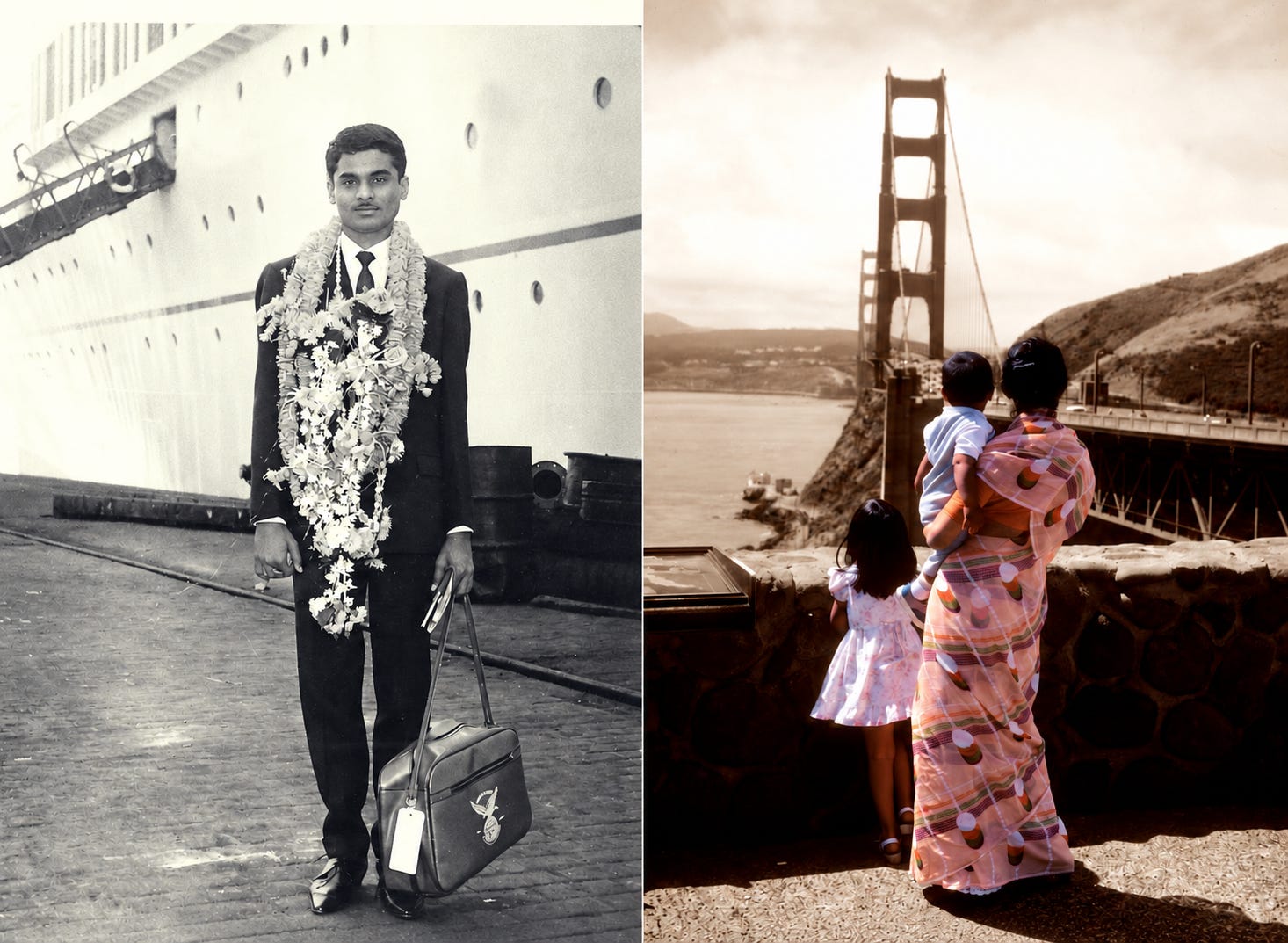
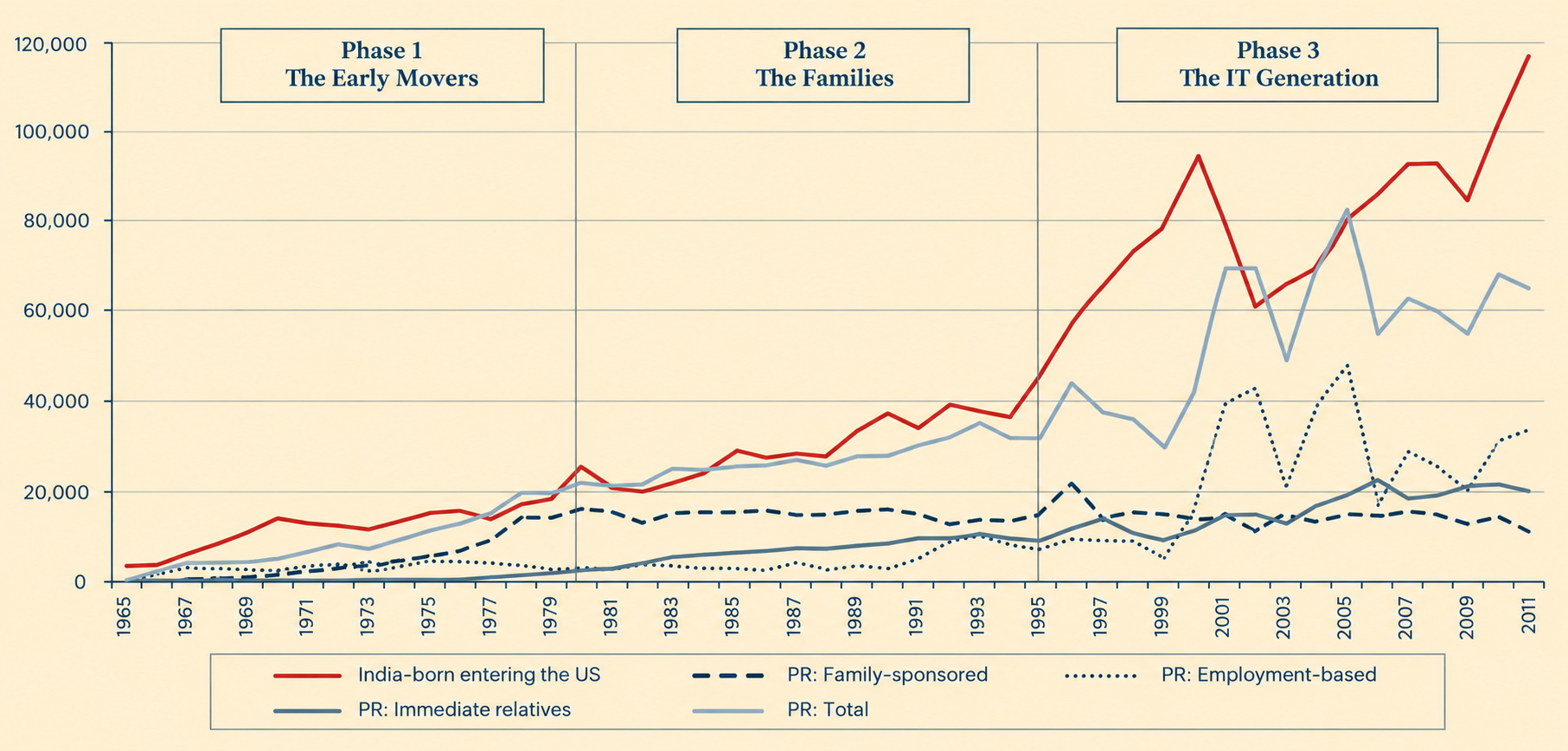
But the big change was America. Until 1965 it let in almost no Indians. The Luce-Celler Act of 1946 had allowed just 100 Indian immigrants a year, and when the US census counted its India-born population in 1960, it found only about 12,000 people in the whole country. In 1965 the US ended the national-origin quotas that had all but shut out Asians, and it began admitting skilled immigrants. This was a very different kind of migration. Sanjoy Chakravorty, Devesh Kapur and Nirvikar Singh, in The Other One Percent: Indians in America, call the first wave the Early Movers. Between 1965 and 1979 about 12,000 India-born people arrived in the US each year, and 45% of them had, or later earned, graduate or professional degrees, especially in medicine. From the 1980s to the mid-1990s family reunification became the main route in, and their relatives followed.
Kapur and his co-authors explain why Indians in America have done so well through selection. They were filtered three times: first by a social hierarchy at home that largely restricted higher education to the better-off, then by an exam and fee system that narrowed the pool further, and finally by an American immigration system built to admit people who matched its high-end labor needs. Measured by college degrees, the India-born in the US were roughly three times as educated as Americans as a whole and nine times as educated as Indians back home.
Even so, the numbers had started small. Getting a passport was at the government’s discretion until the Supreme Court ruled otherwise in 1967, and foreign exchange was tightly rationed. There was also a strong early sentiment about staying on to build the country. Say what you will, but creating a new nation does unleash a certain ambition in its people. Whether it was building new cities, big dams, the IITs, steel plants or a space program, the pride and scale of building a new nation kept some of the brightest Indians at home.
1991 as a watershed
What really changed the game was 1991. It was a watershed, and a moment of real renewal that in hindsight was second only to 1947. But it was a different kind of renewal from 1947. It unleashed individual ambition far more than it revived any shared national project, and it arrived just as the world was globalizing faster than at any point since before the First World War.
For the ambitious Indian, several things came together at once to make America the natural place to realize that ambition. America’s Immigration Act of 1990 created the H-1B visa and raised the number of employment-based green cards from 54,000 to 140,000 a year, just as American companies began scrambling for programmers. Indian IT firms built whole businesses on sending engineers to client sites in the US. (I wrote about how Infosys built that model in “Source Code”)

At home, liberalization eased the old controls on foreign exchange and travel, and the rapid privatization of higher education multiplied the number of engineering graduates. Kapur and his co-authors call the people who came after 1995 the IT generation. They arrived at about 65,000 a year on average, and at well over 120,000 a year by the end of their study period. About three-quarters of the India-born people in the US arrived after the mid-1990s.
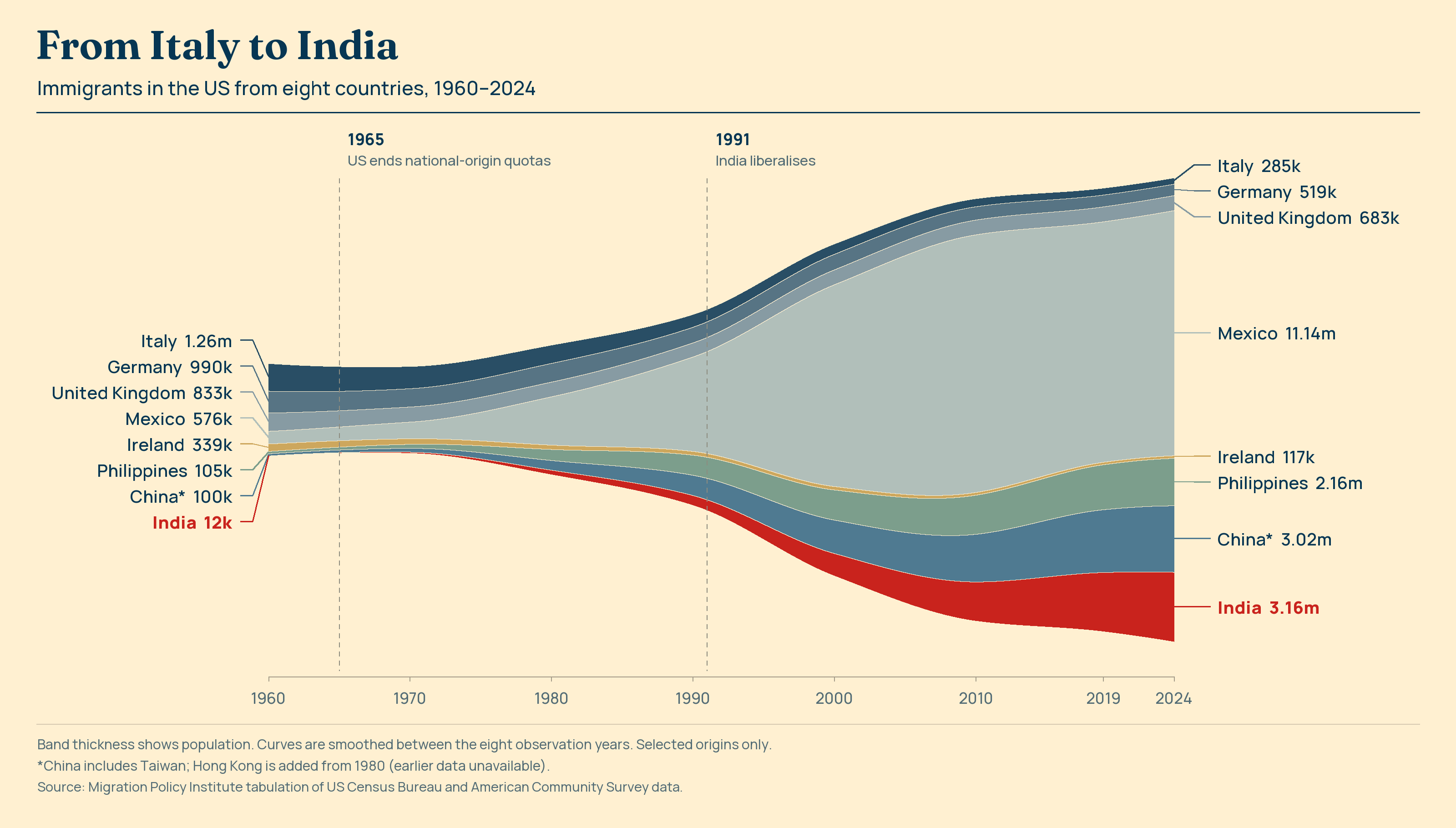
You can see the effect from the American side. In 1960 Italy was the largest single source of immigrants in the US, with about 1.3 million people, followed by Germany, Britain and Mexico, with Ireland not far behind. There were just 12,000 or so Indians. By 2024 the Italian band had shrunk to under 300,000 and the Irish to about 120,000, partly because older migrants died and partly because those countries got richer and their people stopped coming. India had grown to 3.2 million, and almost all of that growth came after 1990.I think of this as a kind of relay. Each era of American immigration has had its dominant groups, which eventually stop coming and simply become American. The Italians and the Irish went that way. Indians may well be next, either because India gets richer or because America closes the door. The current backlash against H-1B workers suggests the second could come first.
That said, Indian immigration to the US is unusual in one important way. What struck me in Kapur’s account is how different the IT generation was from the waves before it. The Early Movers and the Families fit the classic pattern of migration, in which some pioneers go first and their relatives follow. The IT generation broke that pattern. They were picked one at a time, for their individual skills, through visas sponsored by individual employers. In this light its nor surprising that households headed by an Indian immigrant had a median income of about $156,000 in 2023.
The opening up of the US was coupled with a change at home as well. The middle class that liberalization created began to withdraw from public life. It moved its children to private schools, its parents to private hospitals and itself to gated colonies with their own generators and water tankers. Leaving the country was the last step of that withdrawal.
The clearest account of this shift that I have read is by Ruchi Gupta, of the Future of India Foundation, who writes the excellent Substack India: Politics, Power & Public Discourse. In a recent piece, “Indian Democracy Has an Aspiration Problem”, she writes:
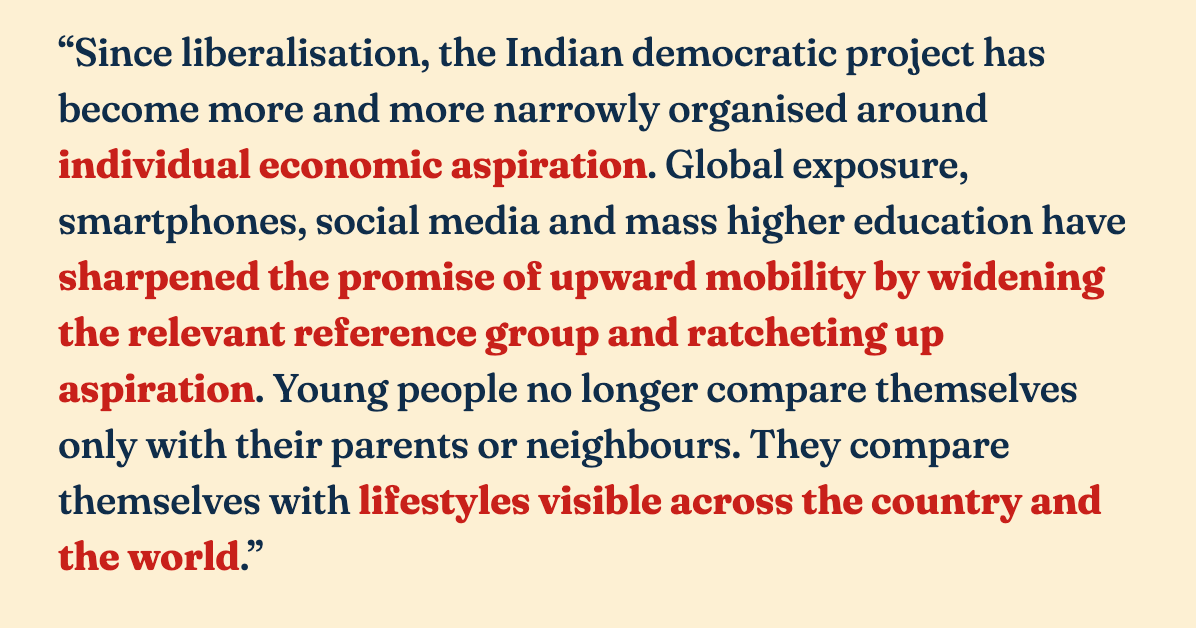
She adds that this comparison is distorted by the algorithm, so that “people see exceptional success presented as ordinary life.” I find this a really useful way to read Deedy’s thread, which is essentially a list of exceptional outcomes offered as the normal path for anyone smart.
It also explains, I think, where the two moral framings I started with come from. When the national project was a collective one, leaving looked like desertion, and that is where the language of the brain drain and of patriotism comes from. Once the project became individual advancement measured against a global benchmark, moving to where that benchmark lives became the fullest way of meeting it.
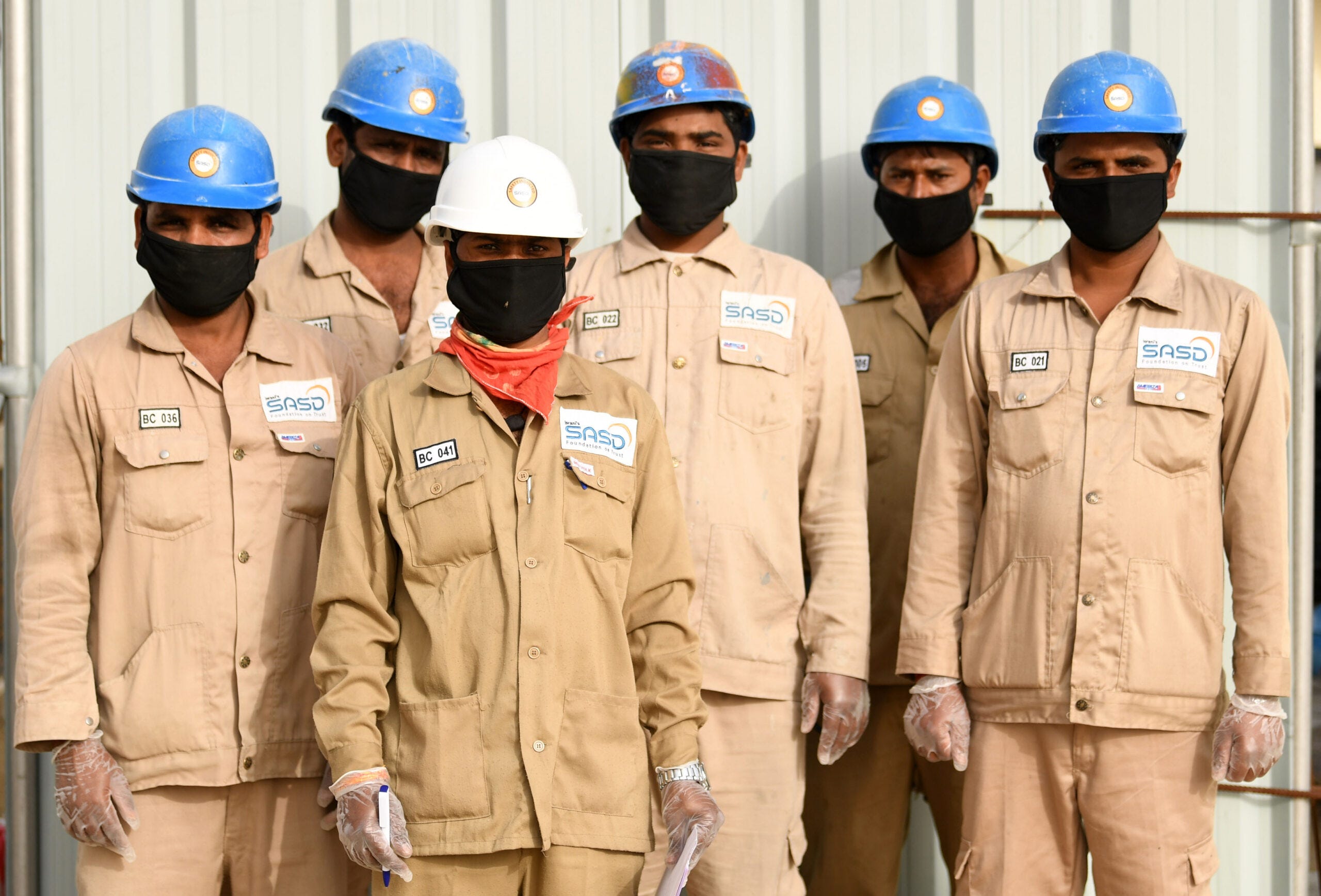
That is why America now dominates how we talk about emigration, even though it is not where most Indians go. The UAE has as many Indian emigrants as the US, about 17% each, and the Gulf as a whole has nearly half. But the money and the status run the other way. In 2023–24 the US was the single largest source of remittances to India, at 27.7%, against 38% for all six Gulf states put together. And the faces of Indian success abroad, from Sundar Pichai and Satya Nadella to Indian-American politicians on both sides of the aisle, are almost all Indian Americans. We don’t valorize M.A. Yusuff Ali, whose LuLu Group runs hundreds of hypermarkets, supermarkets and malls across the Gulf (note: I will forever be a LuLu Mall fan), in the same way. Nor do we valorize Ravi Pillai, who started a construction firm in Saudi Arabia and built the RP Group, which reportedly employs more than 70,000 people, or Azad Moopen, who founded the hospital chain Aster DM Healthcare, even though they are arguably entrepreneurial rather than managerial successes (or perhaps that is why). The Gulf is still seen to largely offer wages, while America offers what it offers best: the possibility of the American dream.
Where from here?
Here is the irony. India is much better off than it was in 1991, and yet more people want to leave. Some of that is normal. In a well-known 2014 paper, the economist Michael Clemens found that emigration from poorer countries usually keeps rising as they get richer, because more people can afford to go abroad, and only starts to fall once incomes reach somewhere around $6,000–8,000 a head in purchasing-power terms. Measured at market exchange rates, India’s income is only about $2,700 a head. But rupees buy far more in India than the same money would in America, so in purchasing-power parity terms India is at about $10,000 a head. Clemens’s figures are in older prices, so the comparison is rough, but it suggests we are probably somewhere near the top of that curve. That doesn’t change the underlying fact that a lot of what is driving this desire to leave is that prosperity has not kept pace with aspiration, or with the jobs and the daily life that people now expect. Our cities are totally broken, as is our corporate working culture. It’s hard to begrudge anyone wanting to leave both. Gupta also argues that national pride is a weak answer to personal stagnation when some people get prosperity and others only get reflected glory. When the country’s achievements don’t feel like they relate to you, getting out is a perfectly rational response.
In some ways the tragedy for the country is not that someone who wants to be the next Sundar Pichai leaves for California. The top 1% of the 1% gravitate to the best opportunities, and this is true in any country. The sad thing is that a driver, a plumber or an electrician cannot get the dignity of decent, steady work at home. We need more of all of them, and more factory workers too, and that kind of work is simply not being created in enough places at wages people can build a life on. The engineer in Seattle and the electrician in Riyadh are responding to the same failure, even if they are rungs apart.
So where does that leave the two moral framings I started with? I don’t think leaving is the proof of ambition that Deedy’s thread makes it out to be, and I don’t think it is a betrayal either. It is a decision people make based on what is on offer at home, and what is on offer can change. India’s 1991 reforms have largely run their course, and the next round has never arrived with anything like the same force. At the same time, the door that 1991 opened abroad, above all to America, is starting to close. Ireland is a good comparable here too. As far as I can tell, it never managed to use patriotism as a stick to shame its people into staying. What eventually brought many of them back (or made them stay) was a country that had become worth coming back to. Plenty of Irish people still go abroad, but going no longer has to mean going for good.
When people ask me why I came back, I find the question a little jarring, as if living abroad had to mean leaving for good, and coming home needed explaining. I have moved a great deal since I first went abroad to study: America, Southeast Asia, Europe, the Middle East. I have learned a lot in every place I have lived and they have shaped me personally and professionally. I would like an Indian to be able to do what an Irish or a British professional now takes for granted: to go, to come back and perhaps to go again, without each move being read as a verdict on the country or on the person making it.
Notes:
Fintan O’Toole, We Don’t Know Ourselves: A Personal History of Ireland Since 1958 (Head of Zeus, 2021). Published in the US as We Don’t Know Ourselves: A Personal History of Modern Ireland (Liveright, 2022).
Patrick Radden Keefe, Say Nothing: A True Story of Murder and Memory in Northern Ireland (Doubleday, 2018).
Central Statistics Office (Ireland), Statistical Yearbook of Ireland 2017, population of the State by census year: 6,528,799 in 1841 and 2,818,341 in 1961. https://www.cso.ie/en/releasesandpublications/ep/p-syi/psyi2017/people/cen/
University College Cork, EMIGRE project, “Historic emigration”. https://www.ucc.ie/en/emigre/history/
Federal Agency for Civic Education (bpb), “Migration and Migration Policy in Ireland”. https://www.bpb.de/themen/migration-integration/laenderprofile/english-version-country-profiles/northerneurope/321571/migration-and-migration-policy-in-ireland
UN DESA Population Division, International Migrant Stock 2024: Destination and Origin, Table 1. Shares and ranking are the author’s calculations, dividing each country’s emigrants by its 2024 population (World Bank). https://www.un.org/development/desa/pd/content/international-migrant-stock
Author’s calculation: about 3.16 million India-born people living in the US in 2024 (Migration Policy Institute tabulation of US Census Bureau data) divided by India’s 2024 population of about 1.45 billion (World Bank). https://www.migrationpolicy.org/programs/data-hub/charts/immigrants-countries-birth-over-time
M.K. Gandhi, An Autobiography, or The Story of My Experiments with Truth, Part I, Chapter 12, “Outcaste”. https://www.mkgandhi.org/autobio/chap12.php
Jawaharlal Nehru, reply in the Rajya Sabha on Indians in Kenya, 18 February 1964 (Nehru Archive). https://nehruarchive.in/documents/in-the-rajya-sabha-indians-in-kenya-18-february-1964-z62dd
Minority Rights Group, “South Asians” (United Kingdom), World Directory of Minorities and Indigenous Peoples. https://minorityrights.org/communities/south-asians/
“Raj of the NHS: How Doctors from India and Pakistan Saved the NHS”, The Health Care Blog, 14 August 2018. https://thehealthcareblog.com/blog/2018/08/14/raj-of-the-nhs-how-doctors-from-india-and-pakistan-saved-the-nhs/
South Asian American Digital Archive, “Today in History: Luce-Celler Act Signed in 1946”. https://saada.org/node/3609
Migration Policy Institute, immigrant population by country of birth, 1960–2024 (MPI tabulation of US Census Bureau data). https://www.migrationpolicy.org/programs/data-hub/charts/immigrants-countries-birth-over-time
Sanjoy Chakravorty, Devesh Kapur and Nirvikar Singh, The Other One Percent: Indians in America (Oxford University Press, 2016), chapters 1 and 2. https://academic.oup.com/book/34828/chapter/297742397
Chakravorty, Kapur and Singh, The Other One Percent.
Pew Research Center, “Indians in the U.S.” fact sheet (American Community Survey data; household income figures for 2023). https://www.pewresearch.org/social-trends/fact-sheet/asian-americans-indians-in-the-u-s/
Satwant Singh Sawhney v. D. Ramarathnam, Assistant Passport Officer, Supreme Court of India, 1967. https://webapi.sci.gov.in/jonew/judis/5154.pdf
Museum of Modern Art, Toward a Concrete Utopia: Architecture in Yugoslavia, 1948–1980, New York, 2018. https://www.moma.org/calendar/exhibitions/3931
Immigration History, “Immigration Act of 1990”. https://immigrationhistory.org/item/immigration-act-of-1990/
Chakravorty, Kapur and Singh, The Other One Percent.
Migration Policy Institute, country of birth data.
Chakravorty, Kapur and Singh, The Other One Percent.
Nileena Suresh, “International migration from India”, Data For India (updated August 2026), based on UN DESA International Migrant Stock 2024. https://www.dataforindia.com/international-migration/
Reserve Bank of India, “Changing Dynamics of India’s Remittances: Insights from the Sixth Round of India’s Remittances Survey”, RBI Bulletin, March 2025, as reported in “Advanced economies overtake Gulf nations in share of remittances to India”, Business Standard, 21 March 2025. https://www.business-standard.com/amp/economy/news/advanced-economies-overtake-gulf-nations-in-share-of-remittances-to-india-125032100650_1.html
“B. Ravi Pillai”, Wikipedia. https://en.wikipedia.org/wiki/B._Ravi_Pillai
Gulf Business, “Top 100 Indians 2025” (profiles of M.A. Yusuff Ali, Dr B. Ravi Pillai and Dr Azad Moopen). https://gulfbusiness.com/top-100-indians-2025/
Michael Clemens, “Does Development Reduce Migration?”, Center for Global Development Working Paper 359, March 2014. https://econpapers.repec.org/RePEc:cgd:wpaper:359
World Bank estimates via StatisticsTimes: India’s GDP per capita was about $2,700 in 2025 at market exchange rates. https://statisticstimes.com/economy/country/india-gdp-per-capita.php
World Bank, GDP per capita at purchasing-power parity, constant 2021 international dollars (about $10,040 for India in 2025), via Trading Economics. https://tradingeconomics.com/india/gdp-per-capita-ppp
Gupta, “Indian Democracy Has an Aspiration Problem”.
On the door closing: T&S Law, “U.S. Department of State and USCIS Announce Immigrant Visa Unavailability in India EB-2 Category”, 26 May 2026, https://tandslaw.com/u-s-department-of-state-and-uscis-announce-immigrant-visa-unavailability-in-india-eb-2-category/; and National Law Review, “$100,000 H-1B Fee on Hold While Government’s Appeal Proceeds”, 29 July 2026, https://natlawreview.com/article/100000-h-1b-fee-hold-while-governments-appeal-proceeds.