

I’m starting a little side project that has always interested me, but that I’ve never really had the time or the space to pursue in any depth. I’m trying to create the time and put in some effort, because I realised there is never going to be a perfect time. You just have to go ahead and make the time to do the thing you actually want to do.
The topic is India’s business history. The interest comes from a place of wanting to understand our own past better. Our history is still quite under-chronicled and, to be honest, far too heavily focused on Bengal, and on the intellectual and the political, at the expense of much else.
India’s business history has long been of interest because it brings together a few different strands of my own life: my training as a historian, my long interest in Indian history, and my daily existence as a person who actually lives in the business world (“foot soldier of capitalism” as I say). With that hat on, it always nags at me that the way we talk about business in India usually starts from a jaundiced view: that business is bad, that merchants are mendacious, that everything ultimately reduces to crony capitalism. That this is the case isn’t surprising in the least given the fact that we were ruled by a company for a century. This perceived deracination by a commercial enterprise seems to have cut a deep wound in us.
Of course, that is the simplified nationalist narrative. When I wrote my book on the Indian soldiers who fought in the First World War, what motivated me was the chance to tell a story that mattered to India’s trajectory and its national movement — a real story of the subalterns — and to make our understanding of the colonial period a little more complex and nuanced. We tend to hold a very simplistic picture of that history, which is unsurprising, because it is always easier to paint the colonial era in broad strokes and the British as the villains. You still see it today in the way a word like “sepoy” is used as shorthand for someone who has sold himself to a foreign master against his own people, even though many of those who took part in some of the most virulent anti-British resistance of 1919 were themselves returning sepoys. I have no wish to apologise for British rule, but the period was genuinely complex, and the way the freedom movement evolved was complex too, and far from straightforward.
Our understanding of business and its history in India suffers, I think, from much the same problem. In public perception the Jagat Seths and their kind are remembered flatly as sellouts who threw in their lot with the Company. These are convenient labels, but they collapse people and motives that were, in fact, far more tangled than the words allow. So, one thread that I’ve wanted to pull on is understanding a bit more how businesses and merchant networks actually operated in the colonial period and the run-up to independence, including how they funded the rise of the British, and then how the landscape shifted such that they came to fund the rise of anti-colonial parties like the Indian National Congress.
I am just beginning to read more deeply on these topics and as I go I’ll use this space to chronicle what I find: thoughts and takeaways, the themes that keep recurring, the things that carry resonance even for our world today. Partly this is a way to keep track of my own reading. But I’d also love the engagement and to hear what others make of it as I go along.
The original ease of doing business story
One of the things I’m reading is the Story of Indian Business series, edited by Gurcharan Das and published by Penguin India. The book I want to write about today is Three Merchants of Bombay: Business Pioneers of the Nineteenth Century, by the historian Lakshmi Subramanian. It’s a short, absorbing account of how the trade and business landscape of western India developed. In particular it charts how Surat, the key coastal gateway to India under the Mughals, slowly gave way to Bombay, which over time became the preeminent commercial city on the west coast.
Subramanian writes about how the Company emerged as a political aspirant in western India, and how that emergence was tied directly to its commercial interests. It set about building up Bombay as an alternative to Surat by persuading merchants and service groups to migrate to the island city, offering them better security and better terms, and in time backing this with naval control of the Arabian Sea. The rise of the Parsis as a major business community is bound up tightly with this story: already an important manufacturing community in Surat, they were among the first to answer the call to settle in Bombay, where they quickly forged connections and built up businesses around things like dockyard building (for example, the Wadia empire traces its origins to these beginnings) and victualling.
But the relationship ran both ways. For the Company too, these communities were the actors that allowed it to thrive and grow. The ability of the bankers and shroffs to raise funds, their skill in revenue administration, their networks for moving money across the geography of India to finance both trade and warfare — all of this was critical. And their decisions about which power to back, tied as those decisions were to protecting their investments and earning a return on them, helped decide the winners and losers of the power struggles that played out across India in the 1700s.
From the early eighteenth century, Subramanian shows, more and more of these service sector communities sensed that the balance of power was tilting towards the Company, and made a conscious choice to align with it, against both the Mughals and the Marathas. The phrase that kept surfacing in my head as I was reading, anachronistic as it is, was ease of doing business.
The Company offered a better environment in which to trade: not just security, but the protection of property, rules and courts to settle disputes, and — crucially — access to sources of revenue that merchants had never had before. It also preached the gospel of free and untrammelled trade, a creed many of these merchants took deeply to heart, in no small part because the Company genuinely did open that wider world up to them. By the end of the eighteenth century, as Subramanian notes, most merchant groups had firmly committed their purse strings to English expansion. It wasn’t really until Gandhi arrived on the scene that their loyalty to the new rulers came under serious challenge.
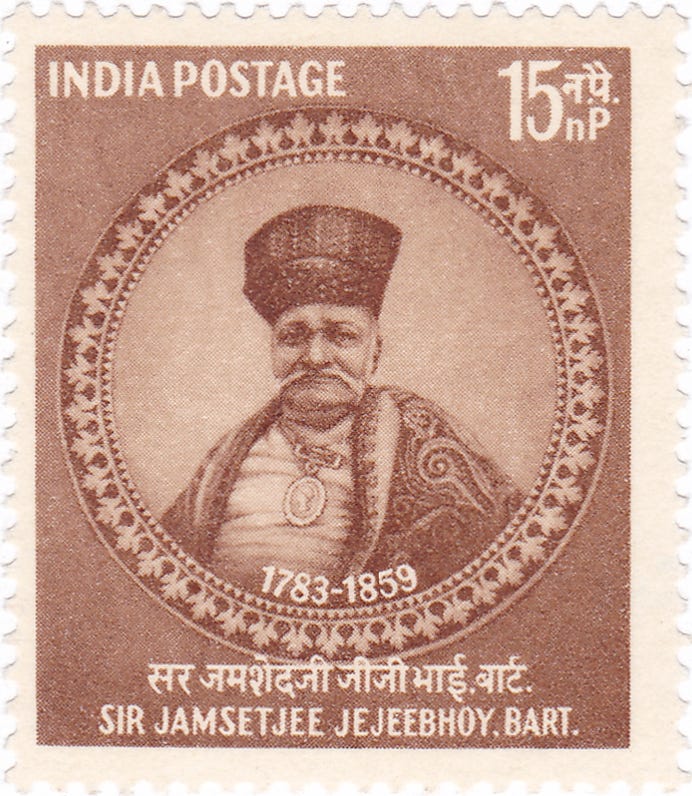
Jejeebhoy on a 1959 stamp marking the centenary of his death
The three merchants the book is built around — Trawadi Arjunji Nathji, Jamsetjee Jeejeebhoy and Premchand Roychand — made their names in exactly this world, founding pioneering empires on the trade in cotton and opium. Of the three, Jeejeebhoy’s is the name Bombay still wears everywhere, from the JJ School of Art to JJ Hospital. Subramanian is careful to argue that their alignment with the British was not, in her words, “purely instrumentalist in scope or sycophantic in application.” These were men playing for very large stakes, looking for a place in global commerce, and through that success they came to shape the public culture of their cities as much as their own balance sheets. The state, in fact, worked closely with Bombay’s leading merchants to build the city; there are several instances of what we’d now call public-private partnerships, merchants and the state coming together in the cause of civic improvement. For men like Jeejeebhoy and Roychand, real estate and urbanisation became a site not only for philanthropy but for navigating the politics of the colonial state itself.
If we hold to the popular view of British rule as having been uniformly bad for the Indian economy, how do we square that with the picture here of Indian traders not merely tolerating the Company but actively choosing it, and prospering by doing so? Here Subramanian invokes the doyen of Indian business history, Dwijendra Tripathi, who argued that British rule did not so much undermine Indian enterprise as provide (if merely by accident) the infrastructure and the broader framework within which Indians could pursue it (through things like transport infrastructure, the abolition of internal customs tariffs, and a legal system that enforced property rights and curbed arbitrary government). Through the Company, in other words, the world of global trade was opened up to Indian merchants. Which is why it is not surprising that they bought so wholeheartedly into its narrative of free commerce. You can still see that legacy today, in the success and the migration patterns of India’s great merchant communities, especially those from Gujarat.
In the end, the takeaway for me was that business then, as now, thinks in narrow terms: profit and loss, access to new markets, the ability to generate returns. These, more often than not, drive the political calculation, which comes a distant second. You could argue that the merchants described, the ones who played such a large part in the opium trade and threw their weight behind the British, were not making morally upright choices. But they were choices that, for those actors at that time, made commercial sense. And they are choices that, in the long run, shaped the commercial engine of India and built its most important city.
Note: Vedica first published this as a note on her personal substack, but we felt these are also the kind of stories the Keeping Up With India readership will enjoy, so we are planning this as an on-going series here.
It still doesn’t show them in very good light to be honest! I do think though, that it’s easy to pass judgement on people from the comfort of the future. In that same place at that time same time, they weren’t the only ones making such decisions. Not everyone can be anti-establishment.